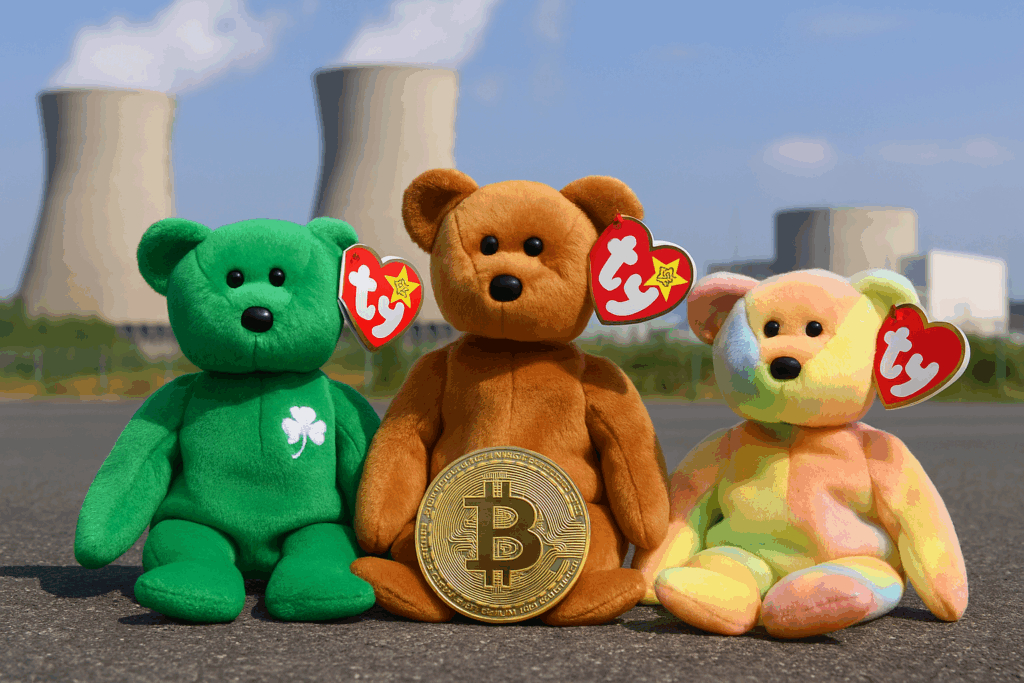
Do you remember the Beanie Baby craze?
In 1998, collectors poured life savings into $5 stuffed animals, convinced they had discovered the next great investment class. Beanie Baby sales topped $1.4 billion that year, a testament to clever supply-chain management and manufactured scarcity. But there was no intrinsic value behind the frenzy, only emotion and marketing. By 2000, the bubble burst, and investors were left holding boxes of plush reminders that enthusiasm alone doesn’t build enduring worth.
Today, some are beginning to ask whether the U.S. nuclear sector’s surge in investment could share that fate.
Valuations are soaring. Start-ups are multiplying. Billions of private and public dollars are flowing into everything from uranium conversion to advanced reactor design. And, inevitably, whispers arise – “Is this just another hype cycle?”
The Fear of the Bubble

The skepticism is understandable. Many of the new nuclear entrants are years away from generating revenue, and some will never become profitable. When capital rushes in faster than projects can mature, comparisons to speculative bubbles come naturally.
Critics often in nations where nuclear remains dominated by state-owned enterprises warn that the American newcomers are “wildcatters” chasing headlines and subsidies. They argue that the sector’s newfound excitement resembles the Beanie Baby craze: lots of passion, little patience, and a looming correction.
But that analogy misses the point. If we must compare nuclear’s current moment to anything, it isn’t Beanie Babies. It’s Bitcoin.
Why Nuclear Is More Bitcoin Than Beanie Baby
Bitcoin, like nuclear today, emerged from a mix of skepticism and conviction.
Its early believers were called irrational, even reckless. Prices soared, crashed, and soared again. Yet beneath the volatility lay something durable: a fundamentally new way of organizing value and infrastructure. Over time, Bitcoin matured moving from the margins to the mainstream, from hobbyist forums to ETFs traded on Wall Street.
The same dynamic is unfolding in nuclear energy. What was once dismissed as obsolete or dangerous is now being re-evaluated as indispensable. Global electricity demand is surging fueled by AI, electrification, and data-center growth and the world is waking up to the fact that intermittent renewables alone can’t keep up. The “hype” around nuclear power is not speculation detached from reality; it’s a rational response to scarcity.
Unlike Beanie Babies, nuclear has intrinsic and strategic value.
It produces baseload power, strengthens energy independence, and underpins national security. The United States cannot achieve true resilience while relying on Russian or even European state-owned suppliers for the conversion and enrichment steps in its nuclear fuel cycle. Rebuilding that capacity domestically is not a fad, it’s a necessity.
The American Model: Risk as Catalyst
In Europe, governments take the lead in early investment.
In the United States, it’s the private sector that moves first and that’s by design. American innovation thrives on a combination of private risk and public policy that rewards success but tolerates failure. It’s the same risk appetite that built Silicon Valley, drove the shale revolution, and yes, propelled Bitcoin from an obscure codebase into a trillion-dollar asset class.
Volatility is not the enemy, it’s the engine.
Some nuclear ventures will falter; others will redefine the energy landscape. That natural selection process driven by private capital rather than centralized planning is how durable industries emerge. Even failures contribute knowledge, technology, and human capital to the ecosystem.
And unlike speculative fads, investors here have mechanisms to manage downside risk. U.S. tax law allows loss harvesting, DOE loan guarantees mitigate financing costs, and the Inflation Reduction Act provides predictable incentives for clean energy deployment. That combination of risk tolerance and structural support is the hallmark of a healthy, not hysterical, market.
Speculation with Substance
Speculation alone doesn’t build power plants, but it does build momentum.
Capital inflows signal belief, and belief funds breakthroughs. Without early-stage speculation, no frontier sector, whether digital currency or nuclear fuel ever scales. The key is that the speculation must rest on substance. And in nuclear, the substance is clear: growing demand, supportive policy, and a profound national-security imperative.
The early years of Bitcoin were marked by volatility and doubt. Yet the idea survived because it solved a real problem—trustless, borderless value transfer in a digital economy. Nuclear, too, solves a real problem: how to deliver dense, reliable, carbon-free energy in an era of rising global demand.
Conclusion: Powering the Next Century
Will nuclear’s resurgence collapse like Beanie Babies or evolve like Bitcoin? The evidence points to the latter.
Yes, we will see turbulence. Some investors will lose money. But those are the growing pains of a sector reclaiming relevance after decades of dormancy. The capital, creativity, and courage now entering the market are not signs of irrational exuberance, they are proof of conviction that America can and must rebuild its nuclear capability.
Beanie Babies promised nostalgia. Bitcoin promised transformation and delivered.
Nuclear promises something even more profound – the power to sustain the digital and industrial revolutions of the next century.
This time, the hype is not hollow. It’s the sound of an industry waking up.