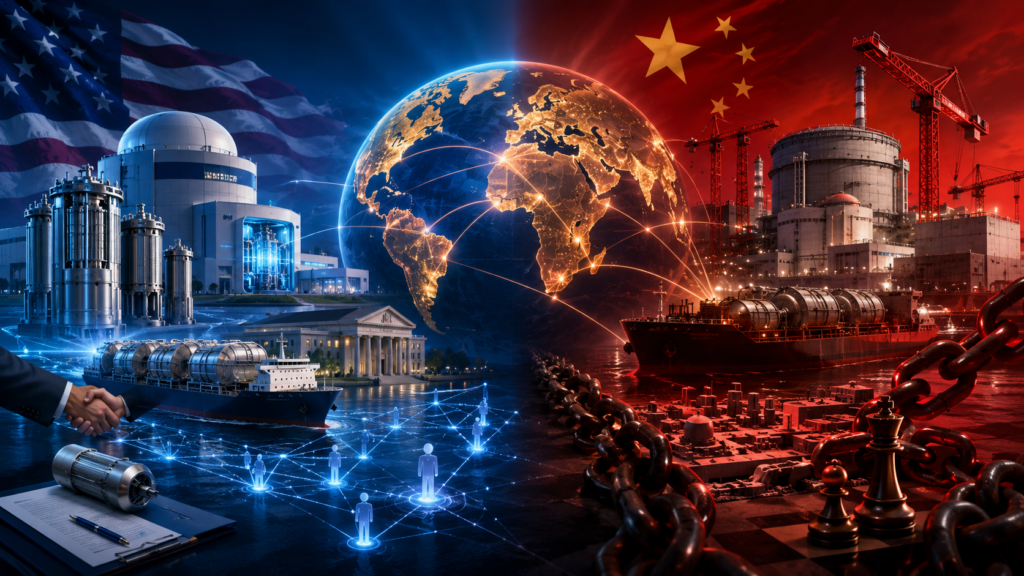
The next nuclear age will not belong to the nation that hesitates the longest. It will belong to the nation that can supply the fuel, set the standards, and earn the trust of the market.
That is why the United States should not treat high-assay low-enriched uranium, or HALEU, primarily as a danger to be contained but rather as the strategic asset it is. If America wants to preserve its competitive advantage in advanced nuclear energy, it must become the world’s most dependable supplier of HALEU: abundant, secure, trackable, and commercially viable. In other words, America must become the Amazon of HALEU before China and Russia become the default vendors of the next nuclear era.
The Market America Cannot Afford to Surrender
The commercial stakes are enormous. Advanced reactors, especially microreactors and other next-generation designs, depend on HALEU to achieve longer fuel cycles, smaller footprints, and stronger performance. Without a dependable HALEU supply, those technologies remain promising on paper and stranded in practice.
That is why the regulatory posture Washington adopts now matters so much. If American regulators decide to treat HALEU as though it were functionally akin to weapons-grade material, the result will be crushing security, transport, and compliance costs that many advanced reactor companies simply cannot absorb. Entire classes of reactors could become commercially unworkable before they ever reach scale.
That would not make the world safer. It would merely hand the opportunity to competitors and adversaries.
China and Russia are already positioned to offer what many smaller nations will find attractive: reactor-and-fuel packages, state-backed financing, and a ready-made alternative to Western delay. If the United States overregulates HALEU into scarcity, it will not eliminate global demand. It will only push that demand toward strategic competitors that are more than willing to fill it.
The real risk is not that America builds too much HALEU capacity. The risk is that American regulation prevents America from assuming global leadership as the supplier of choice.
Call HALEU What It Is
None of this requires pretending there is no proliferation issue. HALEU does raise a legitimate technical concern because its enrichment level makes further enrichment easier than with conventional commercial reactor fuel. But easier is not the same as easy, and it is certainly not the same as inevitable.
The right policy question is not whether HALEU can be misused in theory. Almost any consequential technology can be. The real question is whether the United States can make diversion physically difficult, commercially irrational, and operationally visible through smart regulation and sound engineering.
It can.
That begins with categorization. HALEU should be clearly defined and regulated as a civilian advanced-reactor fuel: more sensitive than conventional low-enriched uranium, yes, but not treated as though it belongs in the same functional category as the materials that drive military security regimes. If regulators collapse those distinctions, they will impose costs so high that advanced reactors lose the economic advantage they were designed to provide.
America does not need a panic standard. It needs a rational one.
Move the Fuel, or Lose the Advantage
No fuel market succeeds on enrichment capacity alone. It succeeds in logistics.
If the United States intends to lead in HALEU, it must be able to transport it quickly, securely, and predictably. That means fast-tracking certification for transportation systems, fabrication systems, overpacks, fuel baskets, and the surrounding infrastructure needed to move HALEU through a commercial supply chain. It also means aligning U.S. requirements with international transportation standards wherever possible, rather than creating a uniquely cumbersome domestic framework that slows American suppliers while others move ahead.
This may sound procedural. It is not. It is strategic.
Countries exploring advanced nuclear power will not only ask who can manufacture fuel. They will ask who can deliver it on time, under clear rules, at predictable cost, with a regulatory system that behaves like a partner rather than a brake. If the United States cannot answer those questions convincingly, another nation will.
Markets do not wait for regulatory perfection. They move toward certainty.
Build Security Into the System From the Start
The smartest answer to HALEU’s proliferation concern is not to suffocate the market. It is to design the market correctly.
Safeguards by design should become the governing principle of the HALEU era. Rather than treating security and nonproliferation as burdens bolted onto a reactor after the fact, safeguards should be integrated into the reactor, the fuel, and the logistics chain from the beginning.
In practical terms, that means sealed cores where possible. It means remote sensors, digital twin technology, continuous material accountancy, tamper-resistant transport systems, and fabrication and packaging systems designed to make diversion extraordinarily difficult. It means building a commercial ecosystem in which fuel is not merely protected at the perimeter, but tracked throughout its life cycle with enough visibility and redundancy to make misuse both hard and obvious.
American innovation will ensure HALEU becomes safe in the real world: not through scarcity, but through abundance paired with control.
A thin, overprotected, underbuilt market is not more secure. It is simply more fragile. A large, transparent, heavily monitored American-led supply chain is what actually strengthens nonproliferation.
America’s Backup Plan Is Already Taking Shape
The encouraging reality is that the United States is not starting from nothing. Pieces of the backup plan are already in motion. Domestic efforts are underway to build enrichment capacity, develop transport solutions, support fuel fabrication, and move advanced reactors toward deployment. The industrial base is trying to form.
What remains uncertain is whether regulation will reinforce that strategy or undermine it.
This is the core American choice. Washington can approach HALEU with a leadership mindset and build the fuel architecture of the next nuclear century. Or it can regulate from fear, slow its own market, and watch competitors convert America’s caution into their advantage.
The Real Risk Is Letting Others Lead
HALEU is not a reason for retreat. It is a test of whether the United States still understands how to lead strategically.
If America builds a HALEU market that is abundant, reliable, and transparent, it will not weaken nonproliferation. It will strengthen it by drawing countries into a rules-based fuel ecosystem anchored by American standards rather than Chinese or Russian dependency. That is the opportunity in front of us.
The real danger is not that HALEU exists. The real danger is that the United States fails to lead the market that will define it.