International sales of American nuclear fuel and small modular reactor bundles may be one of the most important geopolitical opportunities of the century. If America gets the financing right, HALEU and SMR exports can become more than energy products. They can become a strategic hedge against China’s Belt and Road Initiative, a tool for supply-chain independence, and a new pillar of American economic statecraft.
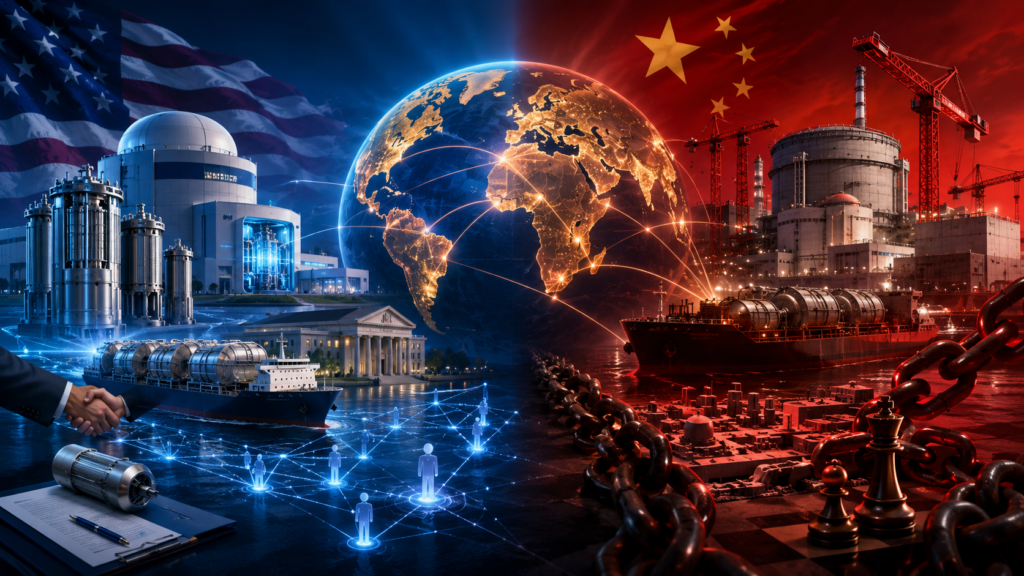
China understands this already. Its nuclear export model is not simply about selling reactors. It is about selling dependency. Through vertically integrated, state-backed packages, China can offer financing, construction, fuel, operations, and long-term service contracts in one bundle. Once a country signs on, it is not merely buying a power plant. It is entering a relationship that can last sixty years or more.
That is the real competition. Not just reactor against reactor. Not just fuel against fuel. It is America’s private-sector innovation and rule-of-law financing against China’s state-directed model of strategic capture.
The Nuclear Life Cycle Is the Leverage
The countries now evaluating nuclear power are not only looking for clean electricity . They are looking for development, industrial growth, energy security, and geopolitical balance. Many are emerging markets with rising electricity demand and limited access to affordable long-term capital. If China offers a “one-stop shop” and America offers a fragmented maze of agencies, approvals, restrictions, and slow financing, the result is predictable.
The United States cannot win a nuclear export race with technology alone. It must finance the technology in a way that matches the life of the asset.
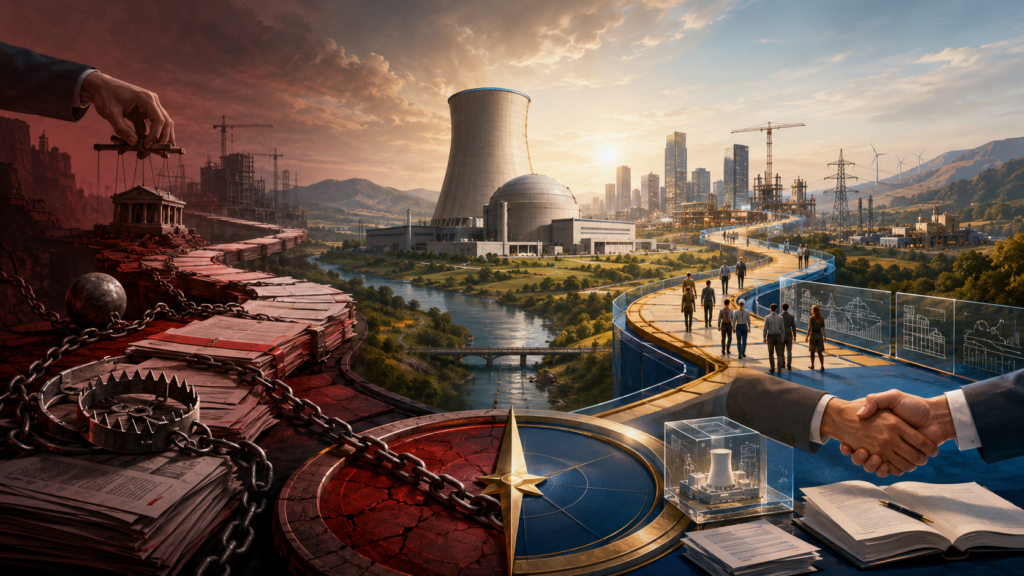
A nuclear reactor is not a short-term infrastructure project. It is a generational asset. Financing that forces repayment too quickly can turn a strategic energy project into a fiscal burden. China’s financing for Pakistan’s Chashma-5 nuclear project illustrates the point: a multibillion-dollar package with heavy Chinese debt, a grace period, and repayment terms that can become extremely burdensome once the grace period ends. America’s answer should not be to copy China’s model. It should be to beat it with something better: transparent, patient, commercially disciplined financing that gives partner countries breathing room instead of trapping them.
Financing Is the Strategy
This is where EXIM and DFC become essential. EXIM can provide the export credit power needed to make American reactors, fuel, components, and services competitive abroad. DFC can take equity, provide political risk support, and make projects bankable in markets where private capital is hesitant to move first.
That combination matters because China’s advantage is not just price. It is coordination. Beijing can move through state-owned enterprises with a bundled offer. America’s challenge is to create the same strategic clarity without sacrificing private-sector discipline, transparency, or congressional oversight.
Recent DFC reforms show that Washington is beginning to understand the moment. The DFC Modernization and Reauthorization Act, included in the FY2026 NDAA, reauthorized the agency through 2031, raised its investment cap to $205 billion, created a $5 billion equity revolving fund, increased equity authority to allow up to 40 percent minority ownership, and permitted limited investment in high-income countries for strategic sectors including energy, critical minerals, and communications technology.
That is exactly the kind of modernization America needs. A DFC that can take equity in an SMR project is not merely a lender. It becomes a partner. That makes American nuclear exports more bankable for countries like Ghana, the Philippines, Vietnam, and other frontier markets that want nuclear power but need credible financing around it.
The First-Mover Race
The countries that move first will shape the market. Poland, Romania, and Ghana are already central to the next phase of American nuclear diplomacy, while countries such as Estonia, Armenia, Jordan, Bulgaria, Vietnam, Kenya, Kazakhstan, Saudi Arabia, Uzbekistan, Malaysia, and Indonesia represent strategic opportunities either to enter new markets or flip markets away from Chinese and Russian influence.
This is where the HALEU hedge becomes powerful. American-produced HALEU, paired with American SMRs and American financing, can offer countries a complete alternative to adversarial supply chains. EXIM has already signaled how this can work, issuing Letters of Interest supporting up to $4.2 billion in potential financing for American enriched uranium sales to nuclear operators in Japan and South Korea.
That should be the model, not the exception.
EXIM Must Be Modernized Too
DFC’s reauthorization was a major step, but it is not enough. EXIM must also be renewed and modernized if America is serious about competing in global nuclear exports.
First, Congress should raise EXIM’s statutory default-rate cap. The current 2 percent cap forces an already conservative institution to become even more cautious precisely when strategic competition requires flexibility. The U.S. Chamber of Commerce has argued that the cap constrains EXIM’s ability to compete with China and should be raised or reformed.
Second, EXIM’s lending cap should be increased to reflect the scale of the opportunity. Nuclear projects are capital-intensive by nature. If America wants to sell reactor-and-fuel bundles internationally, its export credit authority must be large enough to support them.
Third, the domestic content rule should be modernized. American jobs and American manufacturing must remain central, but overly rigid rules can make U.S. bids less competitive in complex global projects. The goal should be to maximize American strategic and industrial benefit, not disqualify otherwise viable deals through outdated formulas.
Finally, duplicative processes between EXIM, DFC, DOE, State, and other agencies must be streamlined. A unified fast-track window for strategic nuclear export packages would allow America to offer partner countries a clear, coordinated proposal instead of sending them through separate bureaucratic channels.
The American Offer
China offers dependency. America should offer a partnership.
The American nuclear export model should be built around transparent financing, private-sector innovation, long-term fuel security, and strategic alignment. HALEU and SMR bundles give the United States a rare opportunity to turn energy exports into geopolitical architecture.
The question is no longer whether America has the technology. It does. The question is whether America can finance, coordinate, and move with the urgency this moment demands.
If it can, the HALEU hedge will be more than an energy strategy. It will be America’s answer to Belt and Road.