
The Kingdom Cascade: A New Architecture for Nuclear Non-Proliferation
Converting Regional Enrichment Tensions into a Financial Engine for Western Nuclear Dominance
Dr. Virginia Davies
I. Abstract
The geopolitical imperative for Western powers to decouple from Russian nuclear capacity has revealed a critical structural deficit in the global fuel cycle. Current Western capital expenditure (CAPEX) and planned infrastructure expansions cannot close the global enrichment supply gap before the 2032–2035 horizon. This deficit threatens to stall the projected nuclear expansion required to power modern industrial bases. Crucially, Saudi Arabia’s massive 17 GW nuclear target positions it as a geopolitical “swing state”; its choice of a Western versus an adversarial fuel partner will fundamentally balance or destabilize the post-2035 global fuel equilibrium.
This paper proposes the “Kingdom Cascade” Architecture, a master-planned framework designed to be settled as part of current U.S.-Saudi Section 123 Agreement negotiations, while remaining mindful of the existing U.S.-UAE bilateral agreement. Drawing precedent from the established Urenco-USA framework, the Kingdom Cascade introduces a novel Ironclad Proxy Structure to decouple asset ownership from operational control. By utilizing Saudi Public Investment Fund (PIF) capital to construct a state-of-the-art enrichment facility on U.S. soil, the model honors Saudi resource sovereignty and delivers absolute fuel security. Concurrently, it converts regional enrichment friction into a commercial engine for Western nuclear dominance, underwriting American economic and strategic hegemony for the next century.
II. Introduction: The Strategic Pivot and the 2035 Supply Crunch
For decades, the United States effectively abdicated its leadership in the front end of the nuclear fuel cycle. Following the Cold War, U.S. policymakers allowed domestic enrichment capacity to atrophy, prioritizing short-term economic efficiency over strategic resilience. The result was a dangerous reliance on foreign, state-owned enterprises—primarily in Russia—to supply the enriched uranium that powers 20% of the American grid.
Crucially, even the infrastructure physically located within U.S. borders was outsourced to foreign-owned private or state-backed European industries. America’s primary domestic supply nodes were not truly American; they were commercial outposts owned by European consortia or foreign corporate boards. This structural abdication meant that nuclear fuel became the recognized “weak link” of U.S. energy security, eroding Washington’s ability to set global non-proliferation standards and ceding market dominance to adversarial powers.
In response to the fracturing of the post-Cold War order, the United States has recently initiated a massive strategic pivot. Washington is now aggressively moving to re-industrialize its domestic nuclear base, evidenced by multi-billion dollar federal investments to jumpstart domestic High-Assay Low-Enriched Uranium (HALEU) and Low-Enriched Uranium (LEU) capacity [the U.S. has committed billions to build out domestic uranium enrichment alternatives]. This resurgence is driven by a dual mandate: the economic imperative to capture the value of the burgeoning global nuclear renaissance, and the national security necessity of decoupling entirely from Russian supply chains.
However, this domestic ramp-up faces an unyielding arithmetic reality. Even with aggressive federal support, the West cannot replace Rosatom’s enrichment capacity—which historically supplied nearly 45% of global Separative Work Unit (SWU) demand—on a timeline that matches projected industrial demand. While domestic Western expansions are underway, they represent a temporary and insufficient patch. Existing construction is simply not scaled to feed the anticipated global renaissance of nuclear power required for intensive industrial expansion, creating a supply trough extending roughly to 2035.
Within this supply bottleneck, Saudi Arabia emerges as the ultimate critical swing state. The Kingdom’s ambitious 17 GW nuclear buildout represents an unprecedented deployment of new capacity. If Saudi Arabia selects a non-Western fuel source, it will structurally fracture the Western nuclear industry and trigger an unmonitored proliferation cascade in the Middle East. Conversely, if Saudi Arabia integrates into the Western fuel cycle, the sheer volume of its demand will completely crash the fragile 2035 Western supply balance unless an entirely new enrichment facility is built.
Traditional non-proliferation instruments, specifically the restrictive “Gold Standard” of U.S. 123 Agreements that outright prohibit domestic enrichment, have become strategic liabilities. They force an unacceptable choice between energy sovereignty and Western alignment.
Historically, the United States has sought to solve its domestic enrichment shortfalls by importing foreign technologies and frameworks—most notably through the Urenco-USA model. Established under the Treaty of Almelo, Urenco represents a tripartite British, Dutch, and German consortium that built the URENCO USA (UUSA) facility in Eunice, New Mexico. While this framework successfully brought gas-centrifuge technology to American soil, it left a glaring strategic vulnerability: foreign control of critical U.S. national security infrastructure.
In previous research, this author has strongly objected to the Urenco framework’s governance, arguing that allowing foreign corporate entities—beholden to European capitals—to dictate the operational priorities, capacity allocations, and strategic direction of domestic U.S. enrichment assets is a fundamental compromise of American energy sovereignty. When a critical node of the domestic defense and industrial supply chain is governed by foreign corporate boards, the U.S. loses its unilateral executive agility.
The Kingdom Cascade resolves this tension. It provides a commercial and regulatory architecture where sovereign capital builds Western-located infrastructure, but does so through a novel legal firewall that completely eliminates the historical pitfalls of foreign operational control.
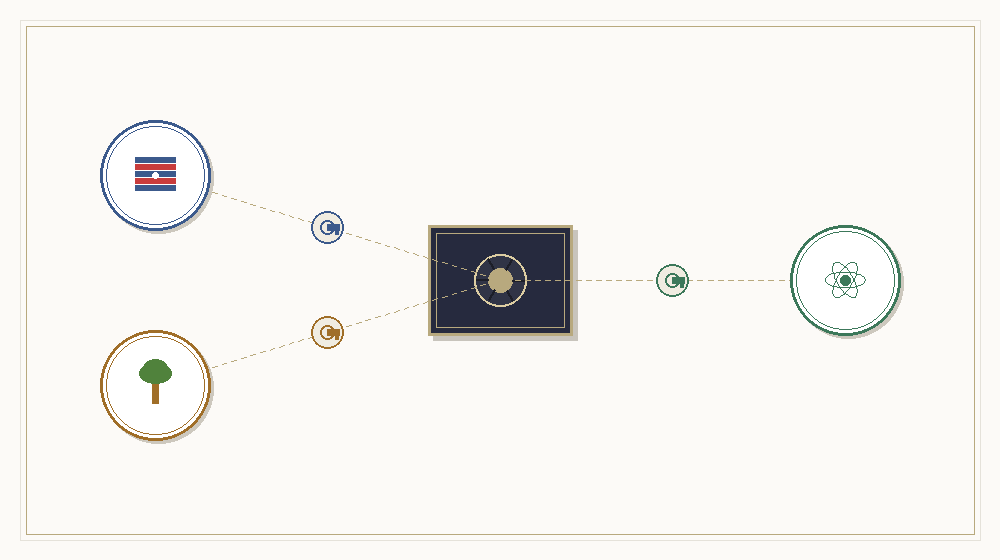
III. The Kingdom Cascade Model: Mechanics & Operational Blueprint
The Kingdom Cascade operates as a master-planned framework integrated directly into the U.S.-Saudi 123 Treaty negotiations. It functions through a precise set of financial, geographic, and legal mechanics:
1. Capital Capitalization and Site Optimization
The Saudi Public Investment Fund (PIF) fully finances the construction of a brand-new, state-of-the-art uranium enrichment facility located inside the United States. While conventional wisdom dictates that greenfield enrichment plants require massive, cost-prohibitive capital expenditures, this model aggressively reduces that burden. By shifting development to an optimized U.S. jurisdiction, the project can capitalize on significant state subsidies and land incentives that could dramatically lower the baseline equity investment. It should not be assumed that this facility would be built in legacy nuclear hubs like Tennessee or New Mexico, nor will it be structured as a mere expansion of existing facilities. It is a distinct, master-planned corporate asset designed from inception to maximize regional tax and infrastructure efficiencies.
2. Resource Sovereignty and Foreign Trade Zone (FTZ) Designation
Saudi Arabia is permitted to mine its own domestic uranium reserves and ship the source material directly to the U.S. facility. This legally and politically confirms Saudi Arabia’s resource sovereignty, transforming the Kingdom into a global resource integrator using its own sovereign property.
To achieve this without compromising domestic legal protections, the physical plant within the U.S. will be designated as a Foreign Trade Zone (FTZ). Under this legal mechanism, the uranium material being processed remains the explicit sovereign property of Saudi Arabia throughout its enrichment life cycle.
3. The Trilateral Escrow Vault and Sanctions Leverage Resolution
To insulate the Kingdom from future U.S. political shifts without subverting American sovereign authority, the framework rejects automated, external material transfers. Instead, it introduces an ironclad legal and physical security valve: The Trilateral Escrow Vault Mechanism.
Should a future U.S. administration attempt to politically block or freeze a legitimate fuel shipment intended for Saudi power stations due to an extraneous diplomatic dispute, the processed fuel does not immediately leave U.S. soil. Instead, the material enters a high-security, physical and legal Escrow Vault located inside the facility’s FTZ perimeter.
- The Trilateral Key System: Movement of material into or out of the vault requires three simultaneous, separate digital authorization keys held respectively by the U.S. Proxy Board, the Saudi PIF, and the International Atomic Energy Agency (IAEA).
- Asset Protection: During an active dispute, the U.S. cannot expropriate or nationalize the material, protecting Saudi capital. Concurrently, the plant cannot re-allocate or sell that specific fuel batch to secondary markets, protecting Saudi property rights.
- Rapid Arbitration: The IAEA is designated as the binding arbitrator, operating within a strict 90-day window. If the arbitration panel verifies that Saudi Arabia has remained in total compliance with its zero-weapons, non-proliferation metrics, the U.S. Proxy key is legally released via automated federal court order under predefined international trade law, enabling immediate delivery.
National security realists and defense traditionalists will inevitably evaluate any fuel-guarantee mechanism with skepticism, arguing that it diminishes Washington’s geopolitical leverage and strips America of a vital foreign policy tool.
However, this critique fails to recognize that the Trilateral Escrow Vault is the very linchpin that makes the entire treaty sellable to a sovereign partner. Furthermore, it satisfies long-term security mandates because the physical material never leaves U.S. borders or IAEA oversight during a dispute. It safely prevents a scenario where an energy-starved Saudi Arabia feels forced to break ties with the West and source emergency fuel from Moscow. It effectively exchanges temporary political leverage for permanent, multi-decade structural control.
IV. Governance: The Ironclad Proxy Structure
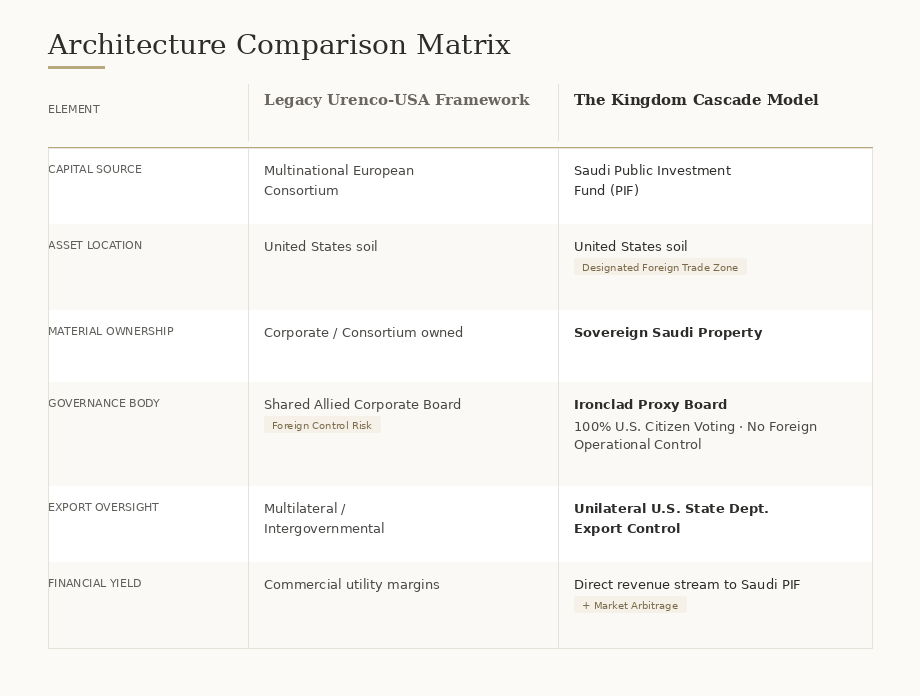
While the Kingdom Cascade shares high-level structural similarities with the spatial footprint of the Urenco-USA framework, it fundamentally diverges by deploying an Ironclad Proxy Structure. This structure is explicitly designed to correct the foreign-control vulnerabilities that this author has previously targeted, ensuring absolute domestic security compliance.
1. The Proxy Board and Export Control
Under this architecture, Saudi financial ownership is entirely decoupled from operational, technological, and strategic governance. Corporate governance is vested entirely in a Proxy Board comprised exclusively of U.S. citizens who hold required federal security clearances. This U.S.-only board holds 100 percent of the voting power on all matters regarding plant operations, physical and cyber security, technology transfers, and day-to-day corporate strategy.
Furthermore, the U.S. Department of State retains unilateral export control. No enriched material or specialized technical data can enter or leave the facility without express federal authorization. This absolute segregation ensures that while Saudi Arabia enjoys the financial yields and resource sovereignty of asset ownership, the facility is insulated from foreign interference. The host nation cannot weaponize the infrastructure, nationalize the assets, or disrupt the domestic U.S. supply chain, directly neutralizing the core objections surrounding legacy foreign-owned nuclear joint ventures.
2. Neutralizing Capital Coercion
Financial experts and sovereignty purists may argue that because the Saudi PIF provides the capital, they hold the ultimate corporate leverage. If Riyadh threatens to halt funding or choke off raw uranium shipments, critics worry they could effectively hold a vital node of domestic U.S. infrastructure hostage through capital coercion.
In reality, the corporate and legal design of the Ironclad Proxy Structure renders capital coercion impossible. Once the PIF capital is deployed and construction is finalized, the assets operate under Delaware corporate laws and strict federal proxy regulations. The Proxy Board possesses exclusive, unilateral voting power over operations and strategy. Any attempt by a foreign funding source to artificially disrupt operations, withhold contracted fuel, or engage in corporate sabotage would trigger immediate, unilateral legal remedies—including federal court intervention and asset insulation under U.S. national security laws. The capital becomes structurally subordinate to U.S. security mandates from the moment it is spent.
3. Architecture Comparison Matrix
V. Operational Economics and Revenue Modeling
The financial model of the Kingdom Cascade is optimized to generate sustainable revenue streams while actively stabilizing emerging markets and reinforcing Western nuclear supply chains. Rather than operating as a speculative asset, the project relies on structural cost advantages and a bifurcated capacity allocation framework.
1. CAPEX Compression Architecture
By shifting development to an optimized U.S. jurisdiction, the project capitalizes on significant supply-side subsidies. Federal tax credits for advanced energy manufacturing, paired with local property tax abatements and state-funded infrastructure grants, combine to absorb a substantial percentage of traditional greenfield construction costs. This external compression dramatically lowers the baseline equity investment required by the Saudi PIF, transforming what is traditionally a high-risk capital expenditure into a lean, highly optimized infrastructure deployment.
2. Production Braid: Domestic Security and Global Arbitrage
The facility’s production architecture is split into two distinct commercial streams:
- The Sovereign Outtake Stream: A dedicated portion of the plant’s operational capacity is locked into long-term outtake agreements to supply Saudi Arabia’s projected 17 GW domestic fleet. By processing its own mined uranium at cost-basis within the facility, the Kingdom insulates its domestic industrial base from macro price shocks, global supply tightening, and spot-market volatility.
- The Export Arbitrage Stream: The plant is deliberately engineered with excess capacity beyond the Kingdom’s domestic requirements. This surplus output is earmarked for export to an approved “White List” of newcomer nuclear nations and market stabilizers (such as Vietnam, Malaysia, and expanding African nations).
3. Commercial Dynamics and the Industrial Feeder-Chain Clause
By pairing the initial CAPEX compression with long-term, high-volume production, the facility achieves a highly competitive unit cost of production. This enables the asset to market its excess capacity at a price point that comfortably undercuts the state-subsidized exports of adversarial nations, effectively disrupting their geopolitical leverage in emerging markets. Because of inherent long-term macro uncertainties, the model avoids relying on static profit projections, instead capturing the premium spread between compressed production costs and global market prices, with commercial profits flow directly to the Saudi PIF.
Crucially, to reinforce global Western nuclear dominance, the commercialization framework implements an Industrial Feeder-Chain Clause. Under this treaty requirement, any newcomer nation purchasing fuel from the facility’s excess capacity must utilize Western-designed, Western-licensed reactor technology (e.g., Westinghouse, GE-Hitachi). This locks emerging economies into a holistic Western industrial ecosystem. It effectively transforms domestic U.S. nuclear technology vendors into aggressive commercial beneficiaries, alignment partners, and political advocates for the facility’s long-term deployment.
VI. Regional Integration and the UAE Asymmetry Solution
To fully mature this model into a self-sustaining regional architecture, the framework includes a formal invitation to the United Arab Emirates (UAE) and its Emirates Nuclear Energy Corporation (ENEC) to participate as founding joint venture partners.
1. The Dual-Class Corporate Share Structure
To accommodate two sovereign entities with distinct diplomatic commitments, the joint venture utilizes a dual-class equity framework under Delaware corporate law, insulated by the U.S. Proxy Board:
- Class A Shares (Saudi PIF): Holds the majority of the economic equity. Class A shares retain the exclusive right to supply the facility with domestic, un-enriched Saudi uranium ore concentrates. This fulfills the political mandate of Saudi resource sovereignty within the FTZ.
- Class B Shares (UAE / ENEC): Structuring the UAE’s participation purely as a financial and fuel-allocation asset. Because Class B shares carry no operational input or rights to introduce domestic enrichment technology, the UAE fully adheres to its landmark 2009 “Gold Standard” 123 Agreement. It introduces zero proliferation risk, yet secures a direct piece of the Western supply chain.
2. Resolving the UAE Asymmetry Dilemma
Skeptics may argue that this structural hierarchy creates a “Sovereignty Asymmetry” that rewards Saudi Arabia’s historical diplomatic resistance with Class A resource control, while penalizing the UAE’s early non-proliferation compliance with passive Class B investor status.
To resolve this regional friction, the corporate charter introduces an Equity Harmonization Framework. While the UAE maintains Class B financial assets to remain perfectly aligned with its 123 text, their shares are vested with Institutional Operational Vetoes. Drawing on ENEC’s unparalleled regional expertise as the successful operator of the multi-reactor Barakah Nuclear Energy Plant, the UAE is granted a structural veto over specific downstream commercial decisions, including the pricing formulas and allocations for secondary market sales to newcomer nations. Furthermore, the charter contains an adaptation clause: should the UAE choose to acquire and source international uranium assets in the future, they retain the option to convert their holdings into a modified Class A tier. This transforms the UAE from a passive backer into the institutional and commercial mentor of the joint venture, rewarding their legacy of compliance rather than discounting it.
VII. Future Horizons: The Evolution toward an Open Architecture
While initially designed as a trilateral master plan for the U.S.-Saudi-UAE nexus, the true structural value of the Kingdom Cascade lies in its scalability. To address concerns from other global uranium-producing partners—such as Uzbekistan—who may object to a perceived diplomatic double standard, the model can evolve from a localized treaty into a standardized, Open Architecture framework for global nuclear governance.
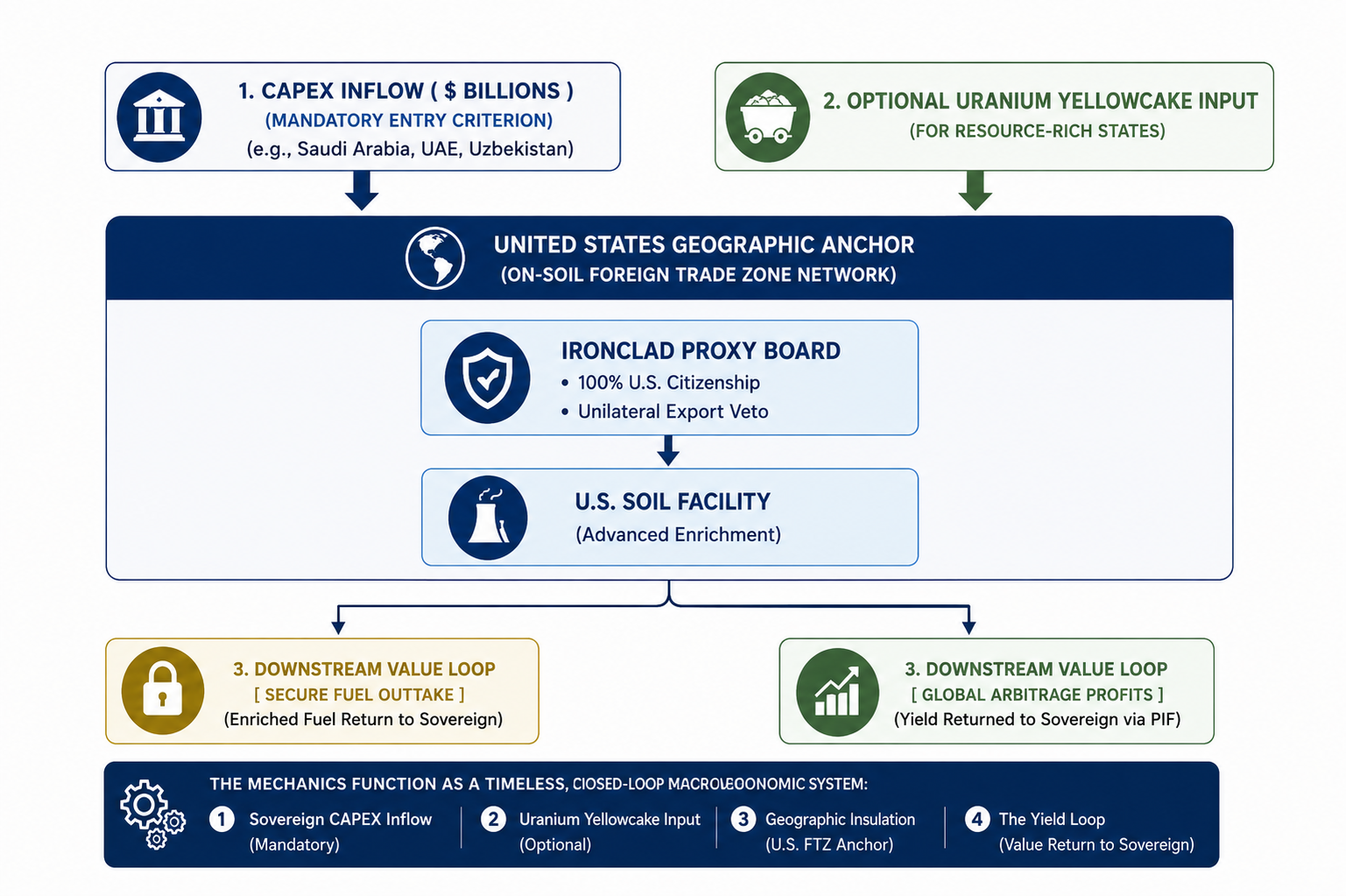
Under this Open Architecture paradigm, the United States serves as the absolute geographic and legal anchor for the global nuclear fuel supply chain. The U.S. State Department would codify an objective, non-discriminatory Accession Protocol. Any verified international partner meeting the baseline requirements would be permitted to route their capital directly onto American soil.
By standardizing the requirements—demanding the same 100% U.S. Proxy Board governance, the same Trilateral Escrow protections, and mandatory adoption of the IAEA Additional Protocol—Washington can completely disarm the “Sovereignty Double Standard” critique.
The mechanics function as a multi-tiered, closed-loop macroeconomic system:
- Sovereign CAPEX Inflow (Mandatory): Emerging economic powers inject billions of dollars in foreign direct investment directly into specialized, state-of-the-art enrichment hubs located at a dedicated U.S. soil facility. This capital contribution is the absolute, non-negotiable mandatory entry criterion for the architecture, building American industrial capacity entirely on foreign funds.
- Uranium Yellowcake Input (Optional): Sovereign partners possessing indigenous reserves, such as Saudi Arabia and Uzbekistan, may choose to ship their raw uranium yellowcake directly to the U.S. facility. This physically and politically validates their resource sovereignty within a protected framework. Crucially, this input is entirely optional; resource-poor but capital-rich states (such as the UAE) remain fully eligible for the architecture by relying on internationally sourced feed materials while still securing their fuel outtake allocations through their upfront financial positioning.
- Geographic Insulation: The physical processing, centrifuge technology, and material assets remain locked within highly secure, U.S.-controlled Foreign Trade Zones.
- The Yield Loop: Once processed, the value splits. The host nations receive an absolute guarantee of secure, enriched fuel outtake—fully realizing their energy independence—while the premium profits generated from selling excess capacity to “White List” newcomer nations flow directly back to their respective sovereign wealth funds.
When negotiating with rising nuclear actors in Central Asia or Africa, the U.S. no longer has to deploy a policy of denial. Instead, it offers a predictable, plug-and-play institutional path: route your mandatory capital to American soil—and optionally your yellowcake—accept our proxy board oversight, and the exact same model of validated resource sovereignty and global financial return is unlocked.
VIII. Conclusion: Defeating the Adversarial Monopoly
The modern nuclear renaissance cannot be sustained by mid-20th-century non-proliferation dogmas. The traditional “Gold Standard,” while well-intentioned, fails to account for a fragmented global supply chain where emerging industrial powers refuse to trade away their energy sovereignty for Western alignment. By attempting to ban domestic fuel cycles outright, the West has inadvertently created a vacuum that adversarial, state-backed entities like Russia’s Rosatom are eager to fill with full-service, monopolistic packages. These adversarial options function as a geopolitical trap, forcing permanent dependency via arbitrary fuel embargoes and capturing a century of national energy outlays into autocratic state coffers.
The Kingdom Cascade systematically breaks this deadlock and defeats the state-backed alternative. It provides a master-planned, pragmatic middle path that honors the political and energy sovereignty of emerging states without fracturing the global non-proliferation architecture. By leveraging the capital reserves of the Saudi Public Investment Fund to construct a highly optimized, state-of-the-art enrichment facility within a U.S. Foreign Trade Zone, the model delivers absolute fuel security—underwritten by a highly balanced, secure Trilateral Escrow Vault—and a profitable infrastructure yield back to the Kingdom. Simultaneously, by introducing the Ironclad Proxy Structure, it directly corrects the critical flaws of foreign operational control seen in legacy frameworks like Urenco, ensuring that 100 percent of voting control, security enforcement, and export oversight remains exclusively in American hands.
Ultimately, the Kingdom Cascade accomplishes a profound geopolitical trade. By pairing highly competitive pricing, unlocked by federal and state incentives, with the structural power of the Industrial Feeder-Chain Clause, the Cascade drives emerging global markets back into the Western industrial orbit. Through the harmonization of regional UAE operational expertise and its long-term scalability into a universal Open Architecture, this framework systematically neutralizes the anxieties of national security realists, defense traditionalists, and financial experts alike. It converts regional enrichment friction into a high-yield commercial engine, secures the global nuclear supply chain, and ensures that the United States remains the undisputed global economic and regulatory power for the next century.